
Over the past 30 years I’ve worked with mining companies, and other asset intensive businesses including food and energy production.
One question keeps coming up, usually from a CEO, CFO or General Manager.
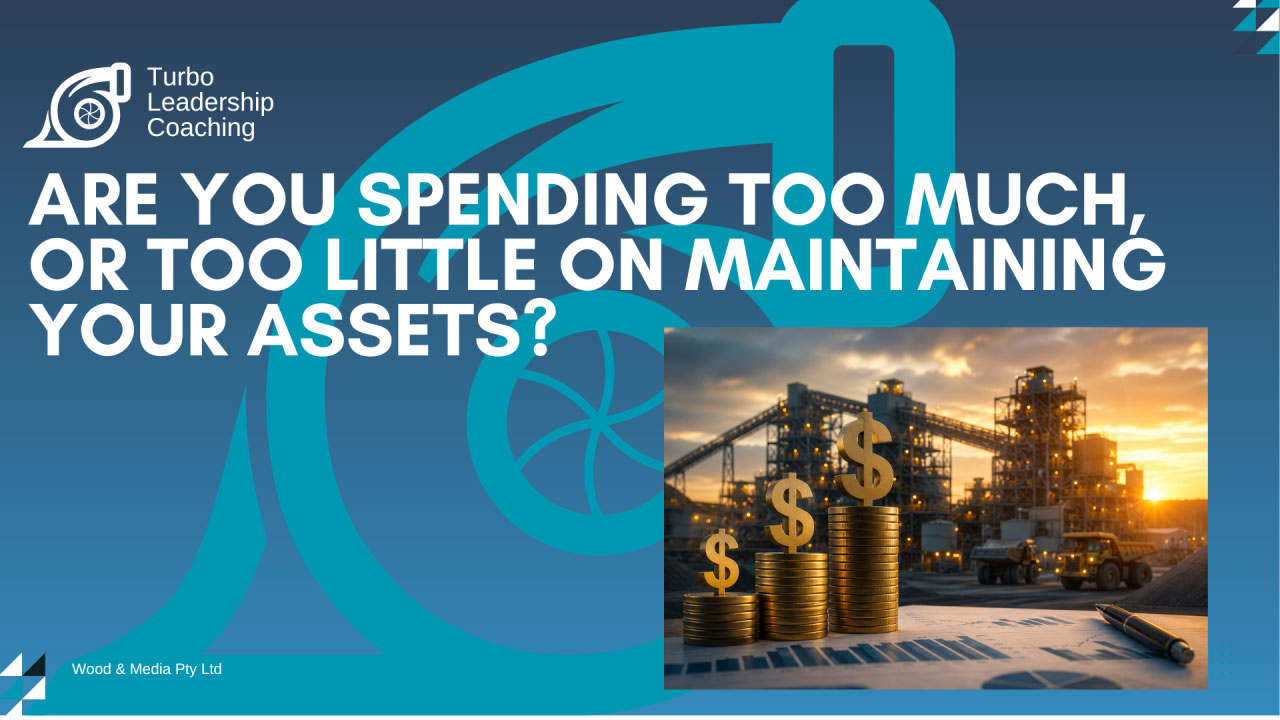
“Are we spending too much on maintenance?”
It’s a simple question, yet I’ve found very few businesses can answer it with confidence. Some believe they spend too much because the maintenance budget increases from year to year, others believe they spend a lot but the equipment keeps breaking down. The reality is that most organisations simply don’t know.
Recently I was working with a business that was producing a food product. One of the first things we wanted to understand was whether maintenance expenditure was reasonable. My first instinct was to apply the similar measures I had used successfully in mining and seen in the food and manufacturing industries. Maintenance Cost to RAV.
While working on gathering the necessary information (which was not readily available and rarely is) I realised that, like in mining, this industry was measuring the maintenance cost to the final product quantity. Yet there are many factors that impact this such as grade or strip ratio in mining, production quality in the food industry or the impact of weather on the outputs from land or animals in farming.
In my book, Simplifying Mining Maintenance, I showed how using Maintenance Cost to Total Tonne Moved is a reasonable metric to use as a benchmark along with Maintenance Cost to RAV, of course.
There is no universal maintenance cost metric that can provide clarity and each business must use a measure that they can benchmark easily and track over the longer term to answer the question.
When executives ask whether maintenance costs are reasonable, the discussion often becomes emotional, perception or opinion based.
One person says: “We’re spending too much.”
Another says: “We’ve underinvested for years.”
Someone compares this year’s budget with last year’s or equipment maintenance cost from year to year without looking at a lifecycle cost model.
None of these really answer the question. Without context and understanding, the numbers become opinions.
One of the first exercises I work through with executive teams is establishing whether the maintenance investment is reasonable before discussing cost reduction.
There are two practical ways to do this.
The first is to compare annual maintenance expenditure against the Asset Replacement Value (ARV or RAV). This gives an indication of how much is being invested each year relative to the value of the assets being maintained and is a reasonable metric when comparing like for like types of assets. For many businesses it can be difficult to find the ARV.
The second is to compare maintenance cost against the business’s primary unit of production that causes equipment to wear.
For example:
The important point isn’t the exact measure. The important point is selecting a measure that reflects why the assets require maintenance in the first place.
Once that measure is tracked consistently over time, meaningful questions can finally be asked.
These conversations are far more valuable than simply asking whether the maintenance budget should go up or down.
You can’t optimise maintenance expenditure until you know what “right” looks like.
The goal is not to minimise maintenance costs. The goal is to invest the right amount to achieve the best bottom line business outcomes the assets exist to deliver. Or optimise the maintenance expenditure.
That’s a very different conversation.
Ask your leadership team one simple question:
“How do we know we’re spending the right amount on maintaining our assets?”
If the answer is based on opinion rather than a repeatable measure, you’ve probably found one of the biggest opportunities for your longer term asset management improvement.